Evolution in radial trends in star formation activity captured at 3 - 4 Gyrs of lookback time
Mun et al. 2024, MNRAS, 530, 5072M
This part of the page is under construction, please refer to a blog post I wrote up here for a short summary of my work for the time being!
Impact of ram pressure stripping on galaxies in the Virgo cluster
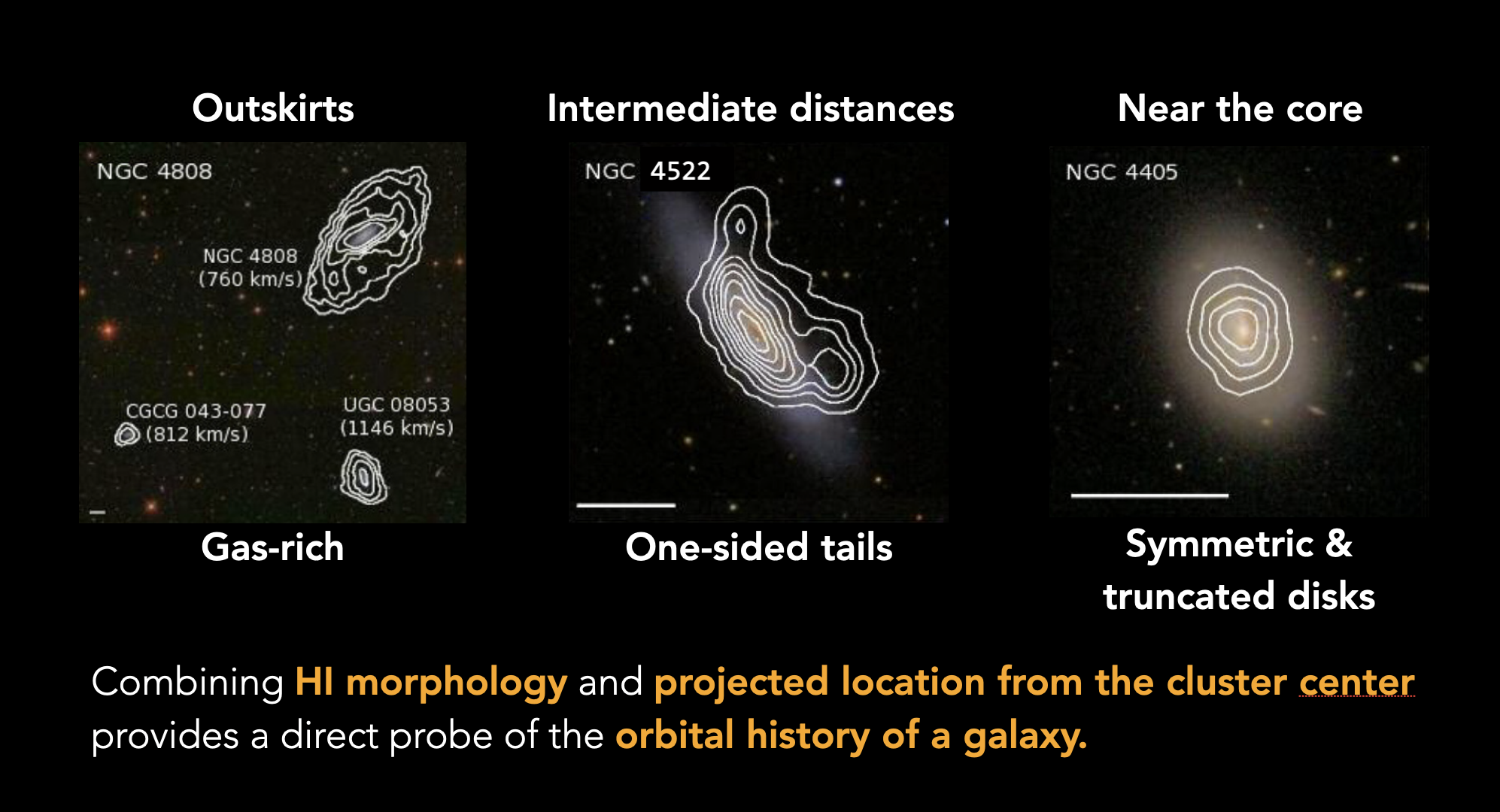
Ram pressure stripping (RPS) is one of the most common mechanisms by which galaxies quench their star formation activity in galaxy clusters, due to the continuous loss of gas to the surrounding intracluster medium (ICM). The close proximity of the Virgo cluster (~16 Mpc) has provided astronomers with spatially-resolved distributions of neutral (HI) and ionized (Hα) hydrogen, for which a trend of decreasing gas content has been observed with decreasing projected clustercentric distances.
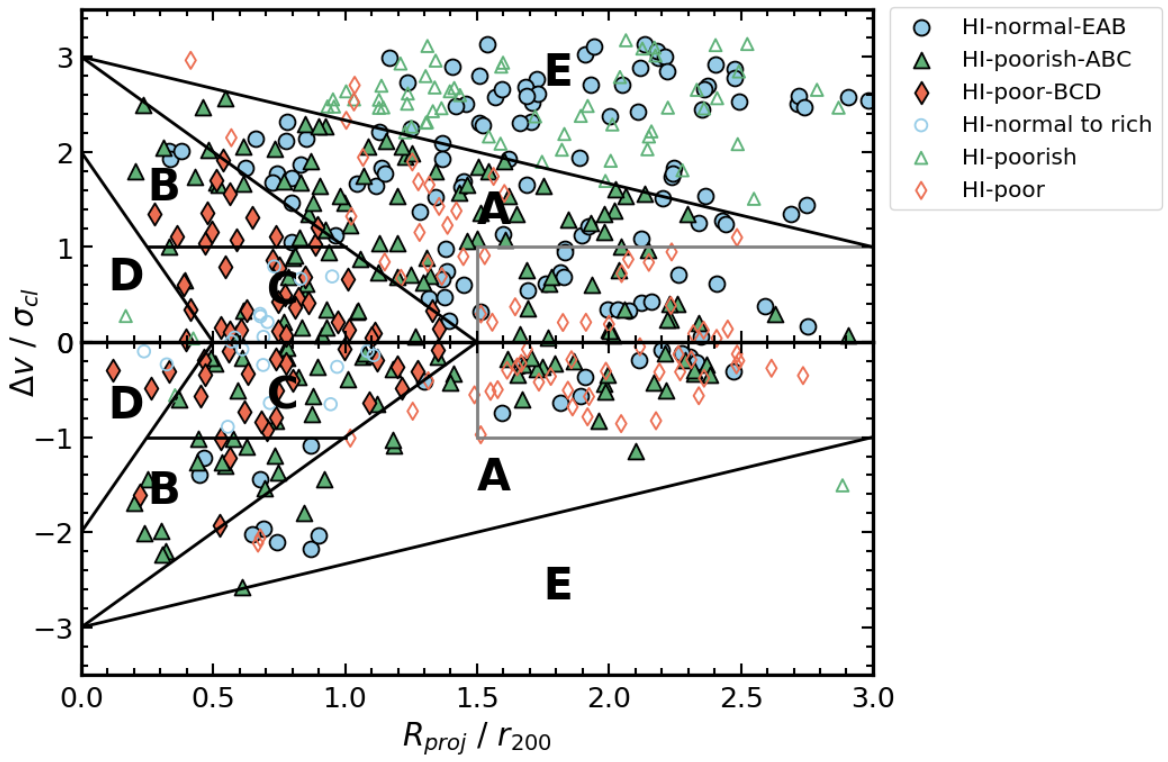
We use a new approach of combining HI-to-stellar mass ratios and location in projected phase space to classify galaxies into different stages of RPS. With this methodology, we confirm that galaxies quench as they continuously lose their gas (decreasing HI-to-stellar mass ratios) and fall further into the cluster center (decreasing offsets in both clustercentric velocities and distances). The greatest advantage of this method lies in its applicability to galaxy clusters at higher redshifts, where obtaining spatially resolved distributions of HI is not as feasible.